Editorial translation; the original Portuguese version prevails in case of discrepancy.
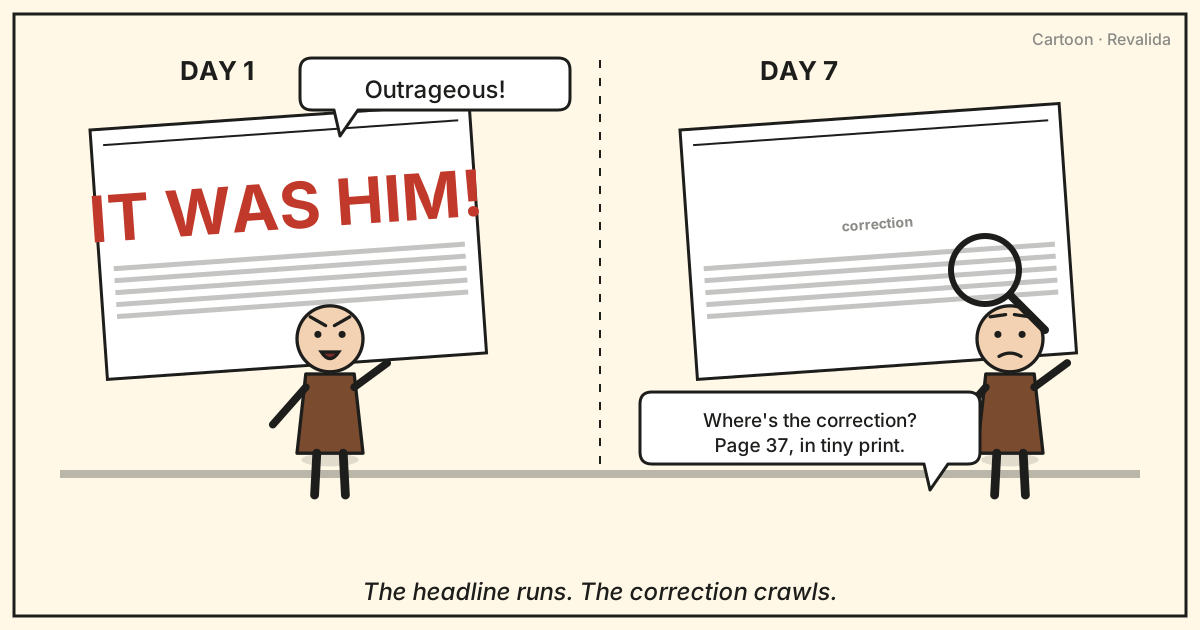
Four times the news came out before the proof. And who corrected it
A hospital in Gaza, a BBC documentary, a front-page photo and the story of the "40 babies": four times the news came out before the proof. In all four cases, the correction came, in writing, from the outlets themselves, from a regulator or from independent fact-checkers.
Analysis
Between October 2023 and July 2025, three major outlets and a regulator stated in writing that they had published information about Israel and Gaza before confirmation. The cases were the attribution of a hospital explosion, the omission of a family tie to Hamas in a documentary, and the context of a cover photo. In the opposite direction, a claim about beheaded babies circulated without proof. The documents are here.
Claim reviewed: An Israeli airstrike hit Al-Ahli hospital on October 17, 2023 and killed 500 people.
| Label | Count | Percent |
|---|---|---|
| Confirmed | 3 | 42,9% |
| Partial | 2 | 28,6% |
| Omitted | 2 | 28,6% |
| Contradicts | 0 | 0% |
| Not verifiable | 0 | 0% |
What we know
- On 10/17/2023, the NYT and the BBC presented or suggested Israeli authorship before any evidence existed; both acknowledged the error in writing within six days or less.
- Canada, France, the United States and Human Rights Watch concluded the most likely cause was a misfired rocket launched from Gaza; Forensic Architecture disagrees.
- Ofcom ruled on 10/17/2025 that the BBC's documentary was "materially misleading"; the BBC had already acknowledged the breach in July.
- The claim of "40 beheaded babies" circulated without verification, and the White House walked back the presidential statement that supported it, on October 12, 2023.
What we don't know yet
- The definitive cause of the Al-Ahli explosion, which no independent on-site investigation has established.
- How Brazil's major outlets headlined the case on 10/17/2023 and whether they corrected it; under investigation.
- Whether the BBC has already read Ofcom's ruling on air, and on what date.
- How many people died at the hospital: estimates range from dozens to hundreds.
On the night of October 17, 2023, an explosion hit the courtyard of Al-Ahli hospital, in Gaza City. Within minutes, the territory's health ministry, run by Hamas, spoke of an Israeli airstrike and 500 deaths. Within hours, the version was in headlines worldwide as fact. Six days later, the New York Times acknowledged, in writing, that it had relied "too heavily on claims by Hamas." [1] The paper stated that the coverage had not made clear "that those claims could not immediately be verified." [2]
The editors' note is the most important document in this case, because the newspaper itself wrote it. It says the report "left readers with an incorrect impression about what was known and how credible the account was." The BBC got there first: on October 20, it stated that "it was wrong to speculate in this way." [1] That came after its correspondent said live on air that it was hard to imagine another cause "other than an Israeli airstrike." [3]
What the documents say about the cause
Canada was the first government to publish a formal assessment. On October 21, the Department of National Defence wrote that its analysis "indicates with a high degree of confidence that Israel did not strike the hospital." [4] The most likely cause, according to the document, was a rocket launched from inside Gaza that misfired. French military intelligence had pointed, the day before, to a Palestinian rocket with a payload of about five kilograms; "none" of its information pointed to an Israeli strike. [5] The American assessment, made public on October 24, reached the same conclusion with "high confidence." [6]
These are not neutral sources, and the piece does not treat them as such. That is why Human Rights Watch matters: an organization usually tough on Israel. It concluded, on November 26, that the available evidence pointed to a misfired rocket launched from inside Gaza, and called for an independent investigation. The research group Forensic Architecture reached the opposite conclusion in October. The cause remains disputed by some; the attribution made that day, as fact, had no basis. [7]
The documentary that did not say who the narrator was
In February 2025, the BBC aired Gaza: How to Survive a Warzone, narrated by a 13-year-old boy. The program did not tell the audience that his father was a deputy minister of agriculture in the Hamas government. The BBC's internal review, published in July 2025, examined more than 5,000 documents and 150 hours of footage. The review concluded there had been a breach of the accuracy guideline and that "the audience should have been informed about this." [9]
On October 17, 2025, the British regulator went further. Ofcom ruled that the program breached Rule 2.2 of the Broadcasting Code for being "materially misleading." The regulator classified the failure among the most serious a broadcaster can commit. Ofcom ordered the BBC to read the ruling on air, at peak viewing time. [8]
The front-page photo
On July 25, 2025, the New York Times put on its cover the image of an emaciated 18-month-old child, as a portrait of hunger in Gaza. Four days later, it added a note: "we have since learned new information" about the boy's pre-existing health problems, which affected his brain and muscle development. The paper removed the mother's statement that he had been born healthy. Based on the clinic treating him, it maintained that he suffered from severe malnutrition. The error was one of context, not of the existence of hunger: the two facts fit in the same sentence, and that is how they should be read. [10]
The same standard, in the opposite direction
A piece about news published before the proof cannot pick a side. On October 10, 2023, a correspondent said live on air that Israeli soldiers spoke of "about 40 babies" killed and, separately, of beheadings. In the hours that followed, the two pieces of information began to circulate as one: "40 beheaded babies."
The president of the United States said he had seen photos. On October 12, the White House walked it back: neither he nor the administration had seen images or confirmed reports. FactCheck.org's fact-checkers recorded that the number was never verified, and that evidence of some beheadings surfaced later. [11] [12]
What the four cases have in common is not the side they favored. It is the mechanism: an interested source, haste, and a headline without the word "says." And what distinguishes them from rumor is what came afterward: an editors' note, a public statement, a review of 5,000 documents, a regulator's ruling and a published fact check.
What we still don't know are the original versions of the Brazilian headlines from October 17, 2023. Public archives did not return them to automated queries; they will be checked by direct reading. We also still lack the full text of the Ofcom ruling, whose automated retrieval was blocked. And we lack the response of the outlets named, which have this space guaranteed. When it comes to facts, there are no arguments. There are documents.
How each article covered it (7 read)
| Outlet | Country | Date | Label | What it reported | What was missing or contradicts | Note |
|---|---|---|---|---|---|---|
| CNN Brasil | Brasil | 17/10/2023 | Confirmed | "Hospital in Gaza is hit by missile": described the event and recorded the versions from Israel and Islamic Jihad. | Coverage from other Brazilian outlets on 10/17/2023 is under investigation: the original versions were not located by machine. | |
| The New York Times | EUA | 17/10/2023 | Omitted | Reported the explosion and the death toll given by Gaza's ministry. | The headline and alert presented the attribution to Israel as fact, sourced from one side of the conflict and without saying it was unverified, according to the editors' note itself. | Corrected on 10/23/2023 with an editors' note. The link points to the note, because the original version was altered. |
| BBC News | Reino Unido | 17/10/2023 | Omitted | Live coverage of the explosion. | The correspondent said on air it was "hard to see what else it could be" other than an Israeli airstrike, before any evidence. | The BBC acknowledged on 10/20/2023: "it was wrong to speculate in this way." |
| PBS NewsHour (AP) | EUA | 17/10/2023 | Partial | Attributed the information to Gaza's health ministry ("health ministry says"). | The original headline stated "Israeli airstrike" as a description of the event; the page's URL preserves the initial headline. | Headline later changed to "Israel and Hamas trade blame after Gaza City hospital explosion." |
| Axios | EUA | 17/10/2023 | Confirmed | "Gaza hospital blast kills hundreds, Palestinian officials say": attributed the source and did not state authorship. | ||
| CNN | EUA | 17/10/2023 | Confirmed | "Hundreds likely dead in Al-Ahli Baptist Hospital blast": used "blast" and "likely," without attributing authorship. | ||
| Al Jazeera | Catar | 18/10/2023 | Partial | Presented both versions, the Gaza ministry's and the Israeli military's. | Called the event a "strike" in the headline, a word that presupposes an attack, when the cause was disputed. |
The labels describe the article on this topic and this date; they do not describe the outlet.
How we verified it and how it was reviewed
We located the documents the outlets and regulators published themselves: the New York Times editors' note, the BBC's statement, the BBC's internal review and Ofcom's ruling, and the New York Times note about the 2025 photograph. For the cause of the explosion, we used the Canadian government's official statement, the French assessment as reported by the Associated Press, the US assessment as reported by The Washington Post and Human Rights Watch's findings, recording Forensic Architecture's dissent. For the babies case, FactCheck.org and CNN on the White House's walk-back. Where the original site blocked automated reading, we say which reproduction we used. The piece went through a technical check and a two-viewpoint review.
Technical check
On 2026-09-30 03:20: 11 of 19 links responded; 4 of 12 cited excerpts were found on the accessible pages; the rest were checked by reading. Links that don't respond to automated requests are noted in the sources.
Reviewer A · viewpoint: defending the outlet and the subject of the story
The text treats the outlets fairly by highlighting that the corrections came from the outlets themselves. Two risks: the "Omitted" label for the New York Times could be read as if the paper never attributed the source, when the headline said "Palestinians Say"; and the section on the 2025 photo needs to make clear the paper maintained its conclusion about malnutrition.
- Objection: The NYT attributed the source in the headline ("Palestinians Say"). Decision: Label kept, because the editors' note itself says the report "did not make clear" that the claims could not be verified; the note in the table records the partial attribution.
- Objection: 2025 photo: risk of suggesting the hunger was fake. Decision: Accepted. The paragraph now states explicitly that the error was one of context and that the paper maintained the severe malnutrition finding.
- Objection: Al Jazeera labeled "Partial" over one word in the headline. Decision: Kept: "strike" presupposes an attack; the body presented both versions, and that is recorded.
Reviewer B · viewpoint: defending the reader and the document
The reader needs to know that the intelligence assessments come from governments allied with Israel, which is why Human Rights Watch and Forensic Architecture's disagreement are essential; both are in the text. It was missing that the cause remains disputed by some and that the death toll was never established. The baby case, in the opposite direction, is what gives the piece the right to be read by either side.
- Objection: Missing the caveat that the intelligence sources are not neutral. Decision: Accepted. Sentence added before Human Rights Watch.
- Objection: Death toll presented without a caveat. Decision: Accepted. Added to "What we don't know yet."
- Objection: Brazilian coverage missing. Decision: Recorded as under investigation, with the reason: the original versions were not located by machine.
Points still in dispute
- Whether "Omitted" is the fair label for a headline that attributed the source ("Palestinians Say") but presented the authorship as the main news. Editorial decision: yes, based on what the newspaper itself wrote in the editors' note.
- Pending sourcing: the figures from the BBC's internal review cited in the body (more than 5,000 documents and 150 hours of footage) and the roughly five-kilogram payload in the French assessment have no literal excerpt recorded in D9 and D5.
- Pending sourcing: the date on which the White House walked back the president's remark is recorded as 10/12/2023 based on the timeline and on D12's date; the original document of the presidential statement is not on the list of primary documents.
Method: review from two viewpoints with declared biases, plus a technical check of links and excerpts.
Human approval on record: Rafael França, on September 29, 2026.
Timeline
Sources
- Editors' Note: Gaza Hospital Coverage“relied too heavily on claims by Hamas, and did not make clear that those claims could not immediately be verified. The report left readers with an incorrect impression about what was known and how credible the account was.”leitura automatizada bloqueada pelo site (403); texto conferido nas reproduções do Times of Israel e do Nieman Lab (fonte 2)
- NY Times admits its coverage of Gaza hospital blast relied too heavily on Hamas claims“relied too heavily on claims by Hamas”
- BBC News deputy CEO admits 'mistake' in coverage of Gaza hospital bomb, Press Gazette (declaração da BBC), 20/10/2023. original“it was wrong to speculate in this way”
- Statement from the Department of National Defence and the Canadian Armed Forces on the recent strike at al Ahli hospital in Gaza“indicates with a high degree of confidence that Israel did not strike the al-Ahli hospital on 17 October 2023”
- French intelligence points to Palestinian rocket, not Israeli airstrike, for Gaza hospital blast“None of their intelligence pointed to an Israeli strike”
- U.S. details intelligence it says clears Israel in Gaza hospital blast, The Washington Post (avaliação do ODNI), 24/10/2023. original“high confidence”
- Gaza: Findings on October 17 al-Ahli Hospital Explosion“apparent rocket misfire (conforme o sumário das conclusões)”conclusões conforme o sumário da própria organização e a cobertura da AP
- Decisão sobre Gaza: How to Survive a Warzone (BBC Two e iPlayer, 17 e 18 de fevereiro de 2025), Broadcast Bulletin 531, Ofcom, regulador britânico, 17/10/2025. original“materially misleading (violação da Regra 2.2 do Código de Radiodifusão)”download automatizado bloqueado; trechos conforme reproduzidos por Variety, Deadline e Euronews em 17/10/2025
- BBC Review Finds 'Gaza: How To Survive A Warzone' Broke Accuracy Rule In 'Serious' Editorial Failure“the audience should have been informed about this”
- NY Times front-page image of emaciated Gaza toddler sparks backlash, then an editors' note, Jewish Telegraphic Agency (nota dos editores do NYT reproduzida), 30/07/2025. original“We have since learned new information”
- What We Know About Three Widespread Israel-Hamas War Claims, FactCheck.org (Annenberg Public Policy Center), 13/10/2023, atualizado em 05/03/2024. original“40 babies beheaded”
- White House says Biden's remark on photos of children was intended to 'underscore the utter depravity' of Hamas attack, CNN, 12/10/2023. original“neither Biden nor the administration had seen pictures or confirmed reports”
Right of reply
No response received so far. People and organizations named can respond through the contact page; the response is published here in full.
Version history
- Version 1 · 2026-09-19 · Piece created from documentary research; Brazilian coverage from 10/17/2023 under investigation.
- Version 2 · 2026-09-19 · Text edit: paragraphs trimmed to a maximum of four sentences; the date of the White House's retraction changed from "the same day" to October 12, per the timeline and source 12; agreement fixed in the closing paragraph; impact highlight marked in each paragraph. No fact, label or document was changed.
- Version 3 · 2026-09-27 · Style and impartiality revision: long sentences split into sentences of 12 to 22 words, verbs standardized to treat outlets and sources the same way (the words "admitted" and "admission" were removed), the dek rewritten so it no longer anticipates the newsroom's thesis about what separates journalism from rumor, and a short title added; no fact, source, label, quote or source marker was changed.
- Version 4 · 2026-09-28 · Removed from the points in dispute an internal editing instruction ('record the excerpt before publishing'); the pending source is still disclosed, with no change to any fact, number or label.
- Version 5 · 2026-09-29 · Human approval recorded by Rafael França; piece cleared for publication.
- Version 6 · 2026-09-30 · Autoria dos documentos citados registrada; nenhum fato alterado